|=[ RESEARCH :: FILE 06 ]=
HOW PRIVATE IS STARKNET'S "PRIVATE" POLYMARKET?
OFFMARKET · STRK20 · POLYMARKET · STARKNET + POLYGONOffMarket promises Polymarket positions that are "not publicly linked to your account", built on Starknet's STRK20 shielded pool. I deposited a dollar, re-indexed every public event on both chains the product touches, and read the JavaScript it ships. The cryptography is fine. Everything around it is not.
DATA · 15.07.2026 → 15.10.2026 · STARKNET + POLYGON MAINNETS
749 BRIDGE-OUTS · 639 DERIVED WALLETS · 1,593 PUBLIC TRADES · ~140,000 POOL EVENTS
FIRST, WHAT IS A "PRIVATE POLYMARKET" MADE OF?
Polymarket's transparency is the point of it and the problem with it. Every position you take sits on your public profile, and OffMarket's own advert puts it better than I can: "Open your own Polymarket profile in a private window. That is exactly what a stranger sees. Every open position, every result, every trade. Would you hand that to someone you've never met?" Their fix: bet from a wallet nobody can tie to you.
The machine they built for it has four hops. You deposit USDC into STRK20, the shielded pool built into Starknet by StarkWare itself, where your balance becomes encrypted notes that only a viewing key can read. The app then derives a fresh Polygon wallet from your signature, one per bet, and bridges your money to it over Circle's CCTP: USDC burns on Starknet, mints on Polygon. A relayer pays the Polygon gas, so the fresh wallet never touches your old one. The wallet places your order on Polymarket's public order book, and winnings bridge back the same way and re-shield into the pool.
Their words: "The Polygon wallet trading on Polymarket looks like a random address with nothing linking it to your Starknet identity, your other positions, or your main wallet." And: "the bridge carries no identifying information."
I have measured the pool underneath this product before. In that study, 40.4% of withdrawal legs were certainly linkable from public data alone, before any product sat on top. OffMarket adds two things to that base: a server in the middle, and a promise on the tin.
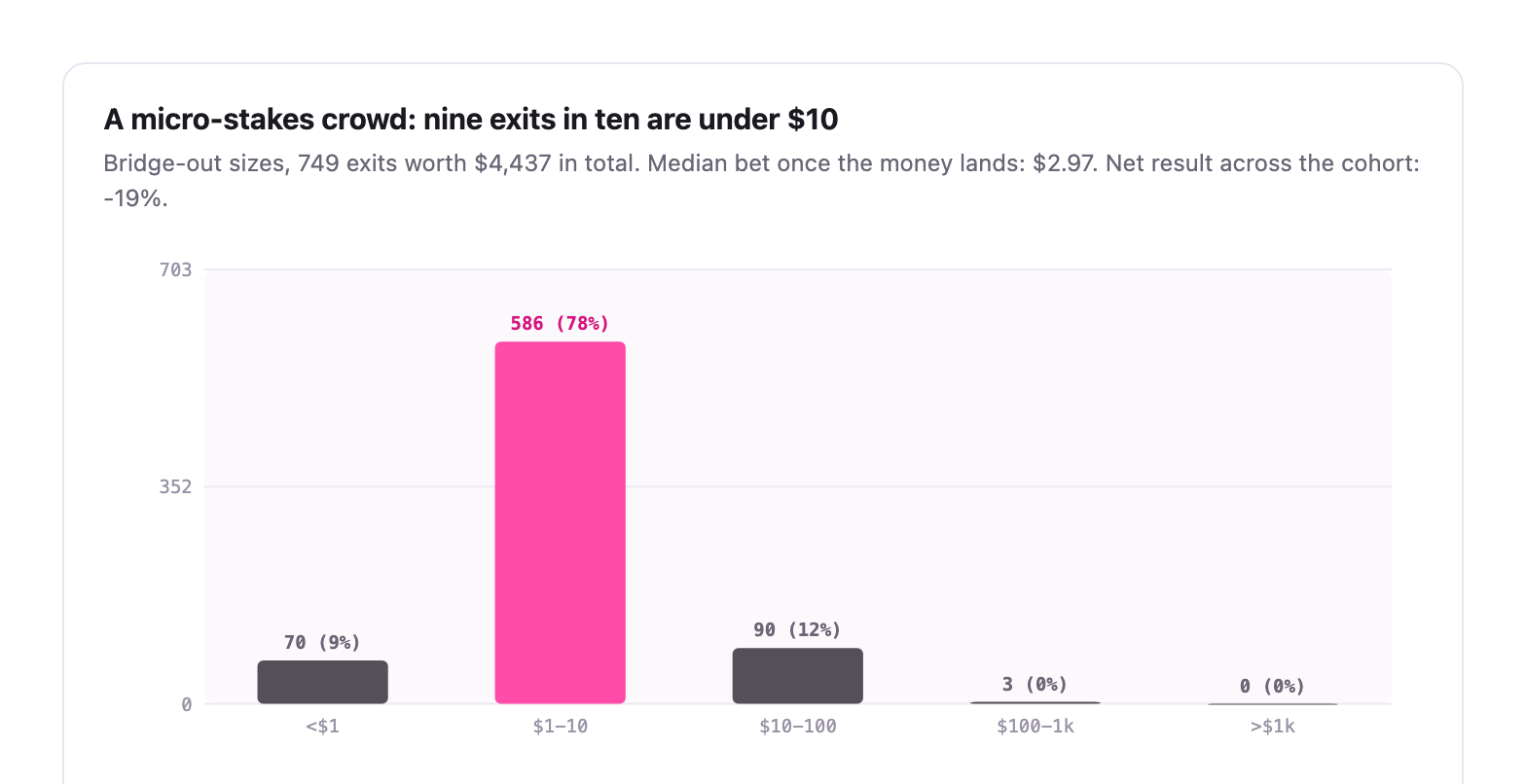
One more product fact, because it cost me real money. I deposited 1.000000 USDC. What arrived, spendable, was 0.746988. A quarter of the dollar gone to fees before I placed a single bet. The median user stakes $2.97 a time, so this is not a whale's complaint: on the amounts this product is actually used for, the fee schedule is the product.
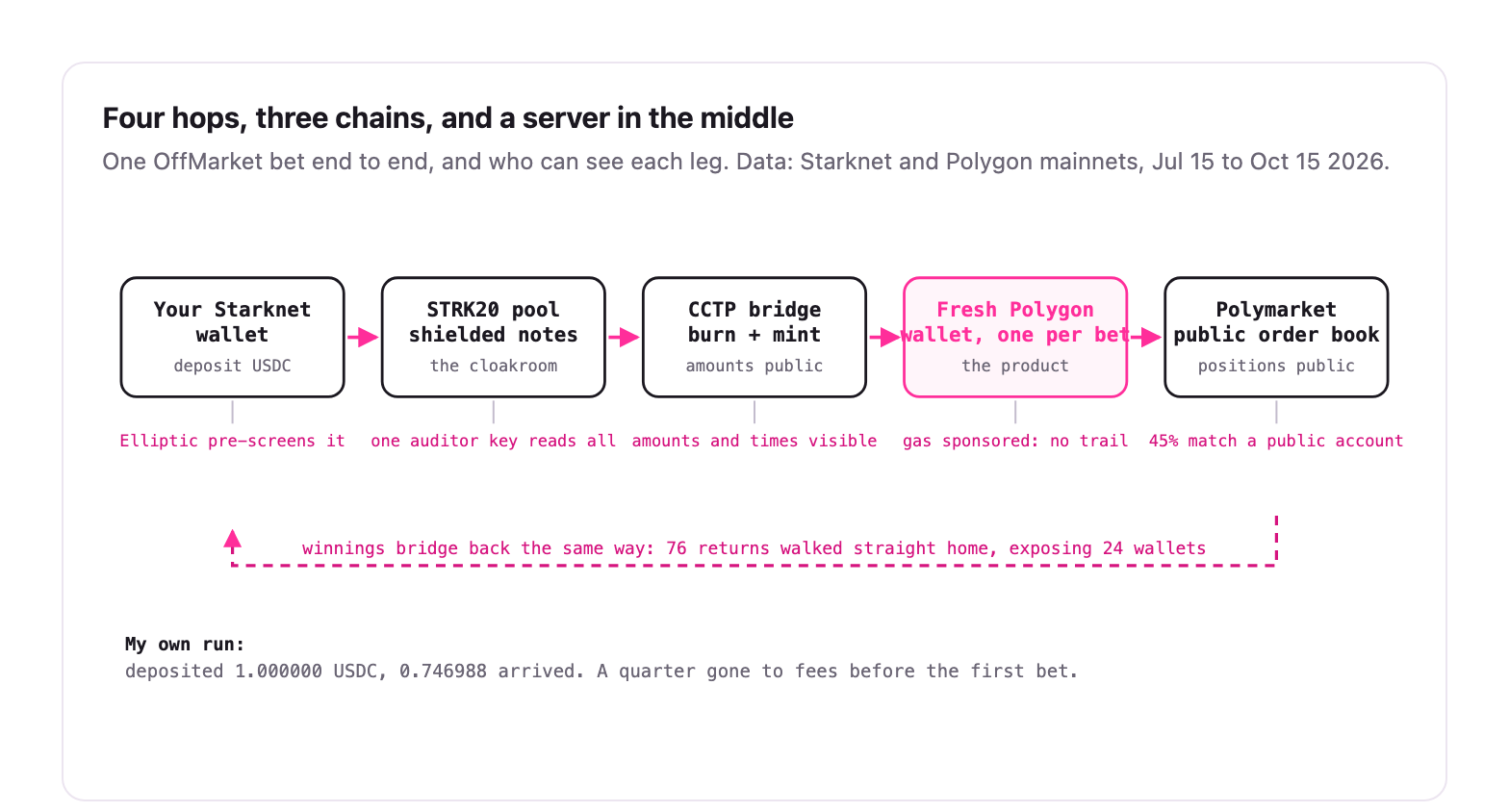
WHAT DID I ACTUALLY DO?
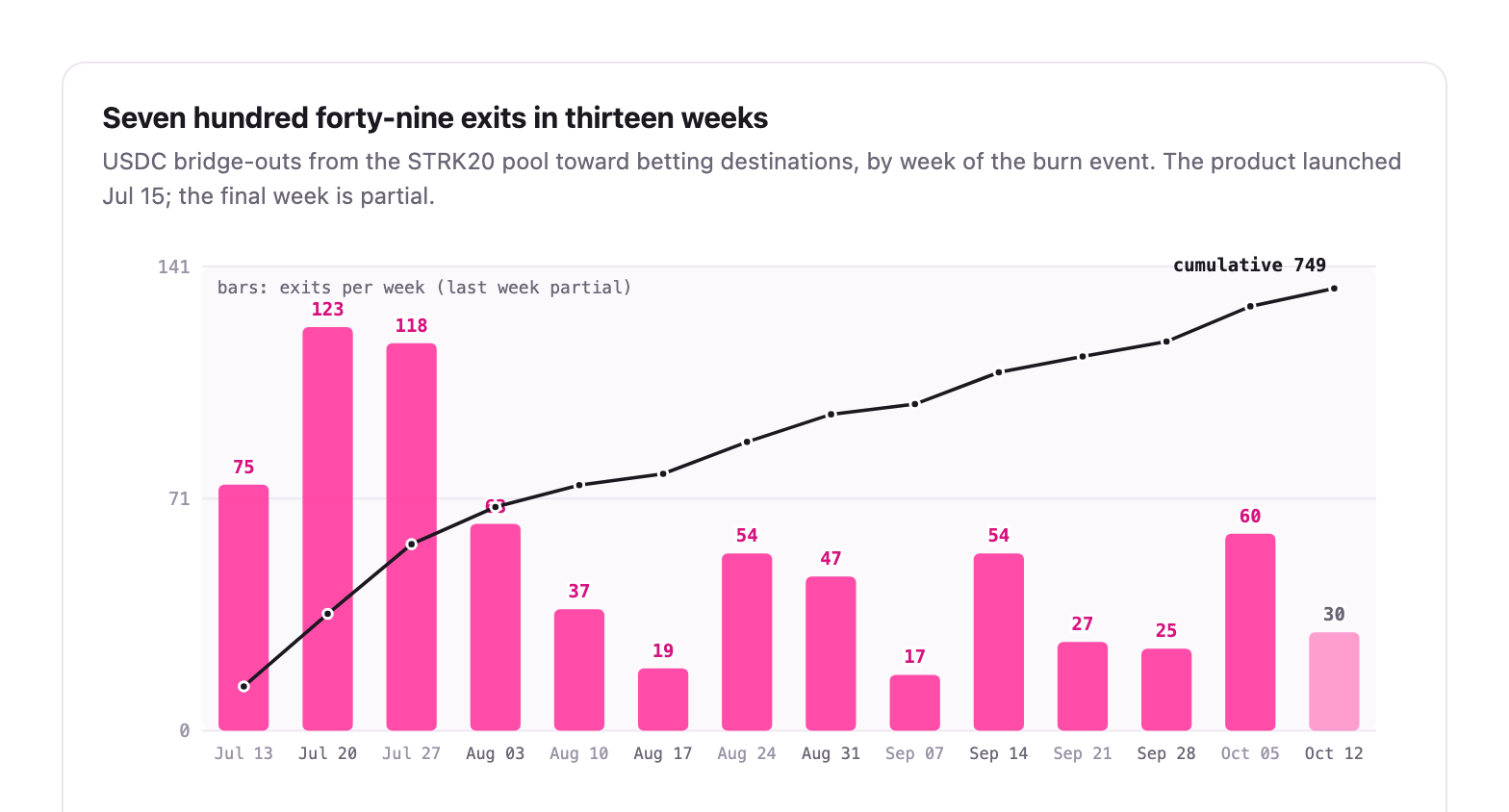
Every action in this system leaves public residue somewhere: a deposit event on Starknet, a CCTP burn with an amount and a timestamp, a fresh Polygon wallet, and, most generous of all, a public trade feed on Polymarket itself. I re-indexed the lot: 749 bridge-outs between July 15 and October 15 2026, the 639 fresh wallets they funded, every trade those wallets placed (1,593 trades across 869 markets), every return leg, and the full event history of the pool behind it all.
Then I asked two boring, nasty questions. First: given only public data, how often can a stranger work out which Starknet depositor owns which Polygon bettor? Second: what does the operator see that a stranger cannot? The first question is about the marketing. The second is about the architecture. Both have answers, and neither is comforting.
A note on method before the numbers: every heuristic below ships with a measured chance rate, computed by re-running the same trick on time-shifted data where no true link can exist. Observed beats chance, or it does not get quoted.
THE CROWD, HONESTLY
Who uses a private Polymarket? Small-stakes coin flippers, mostly. The 749 exits total $4,437: under $6 per hop. Nine exits in ten are under $10, and there is no whale tail to flatter the average: three exits in thirteen weeks cleared $100. Once landed, 89% of exits go to Polygon, where 449 of the 639 wallets placed at least one trade.
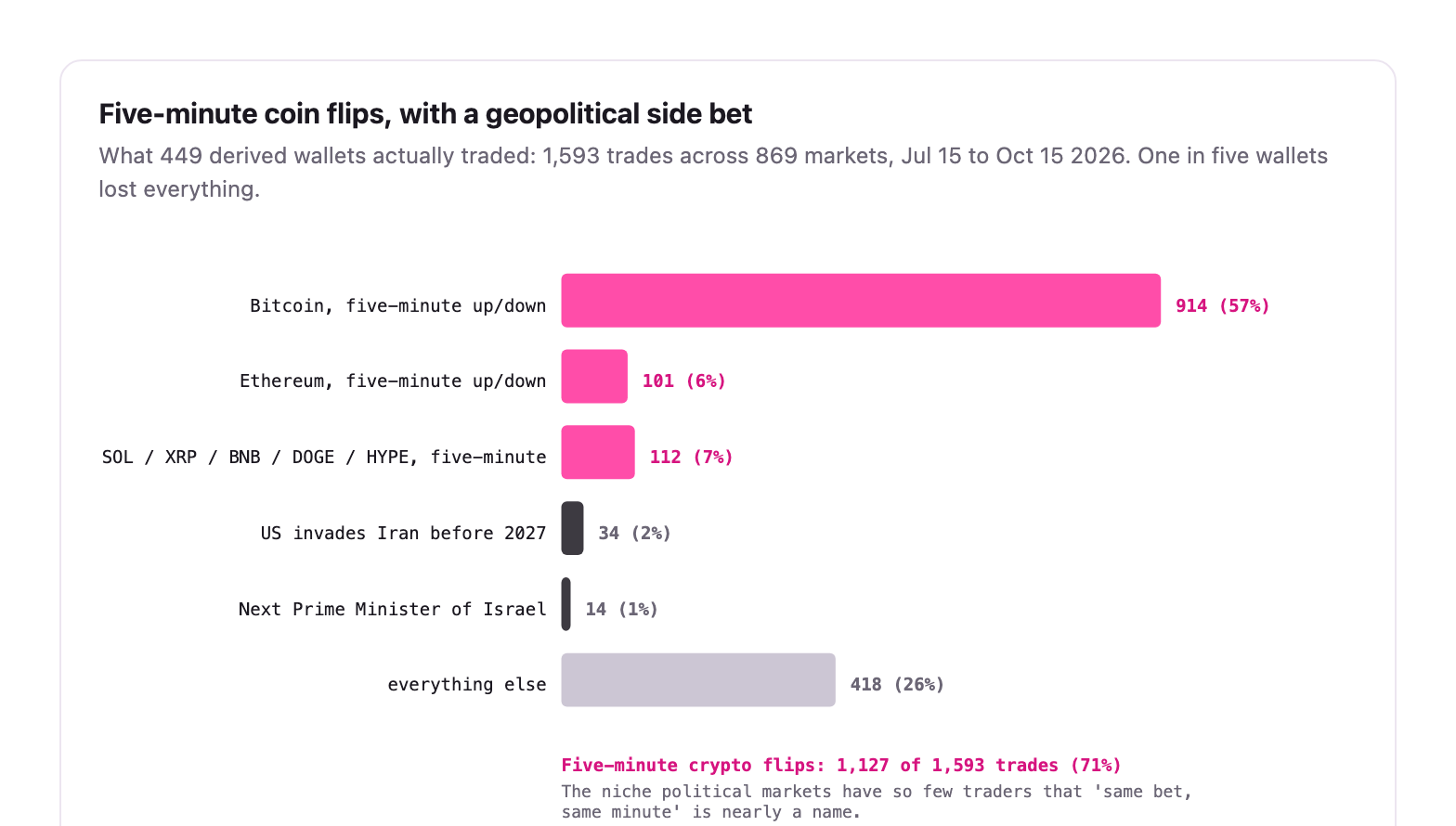
What they buy is not the sophisticated hedge of the marketing deck. 71% of all trades are five-minute crypto up/down flips, 57% on Bitcoin alone. Then a geopolitical cluster: 34 trades on the US invading Iran before 2027, 14 on the next Prime Minister of Israel. And one ZEC conviction bet, holding a position for weeks, which in a crowd this size is practically a signature.
They are not winning. Net P&L across the cohort is −19%, and 22% of wallets lost everything they bridged. This is a crowd you could fit in a cinema, losing money together in five-minute increments, and paying up to a quarter of their stake in fees for the privilege of doing it privately.
THE LEAKS, RANKED
I tested eight ways an observer might tie a Polygon bettor back to a Starknet depositor, ranked by the damage they do. Two numbers decide each entry's place. Reach: for how many of the 749 exits does the trick produce an answer? Strength: when it speaks, how much should you believe it? The bottom entry is the duds, reported with the same care as the hits, because an honest study reports its nulls.
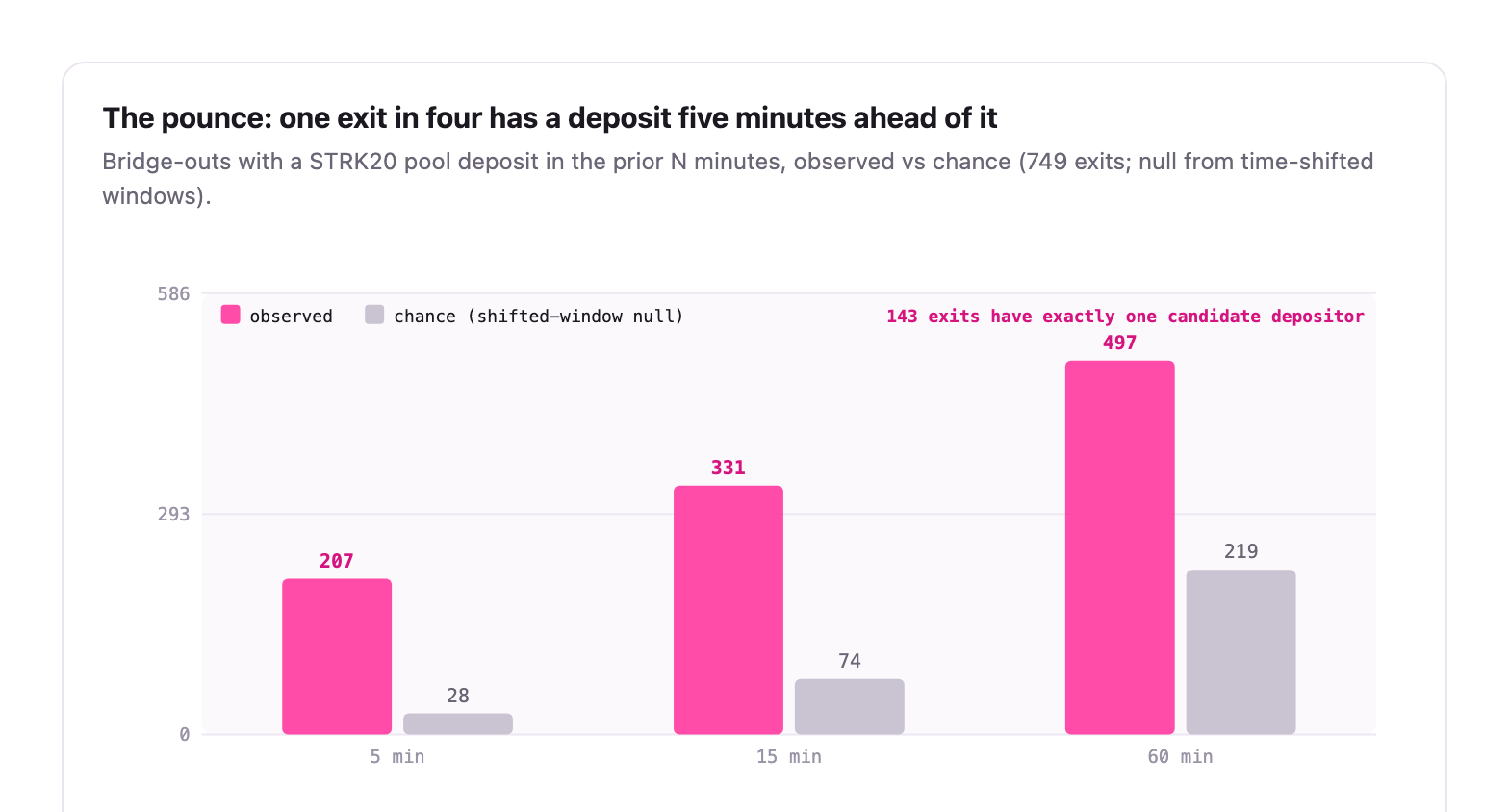
#1 · The pounce (timing)207 of 749 exits have a pool deposit in the five minutes before them. Chance says 28.
The product's own speed is the tell. OffMarket is designed for a single sitting: deposit, bridge, bet, all before your coffee cools. But a deposit is public and a burn is public, and when exactly one depositor moved money in the minutes before a burn, the cloakroom has one coat in it. 143 exits have exactly one candidate depositor in that window; at two minutes it is 101.
A candidate is not a name. It is, however, the difference between "could be anyone" and "is one of a handful", and every later entry in this list stacks on top of it. You cannot use the product as marketed and avoid this leak: the convenience is the fingerprint.
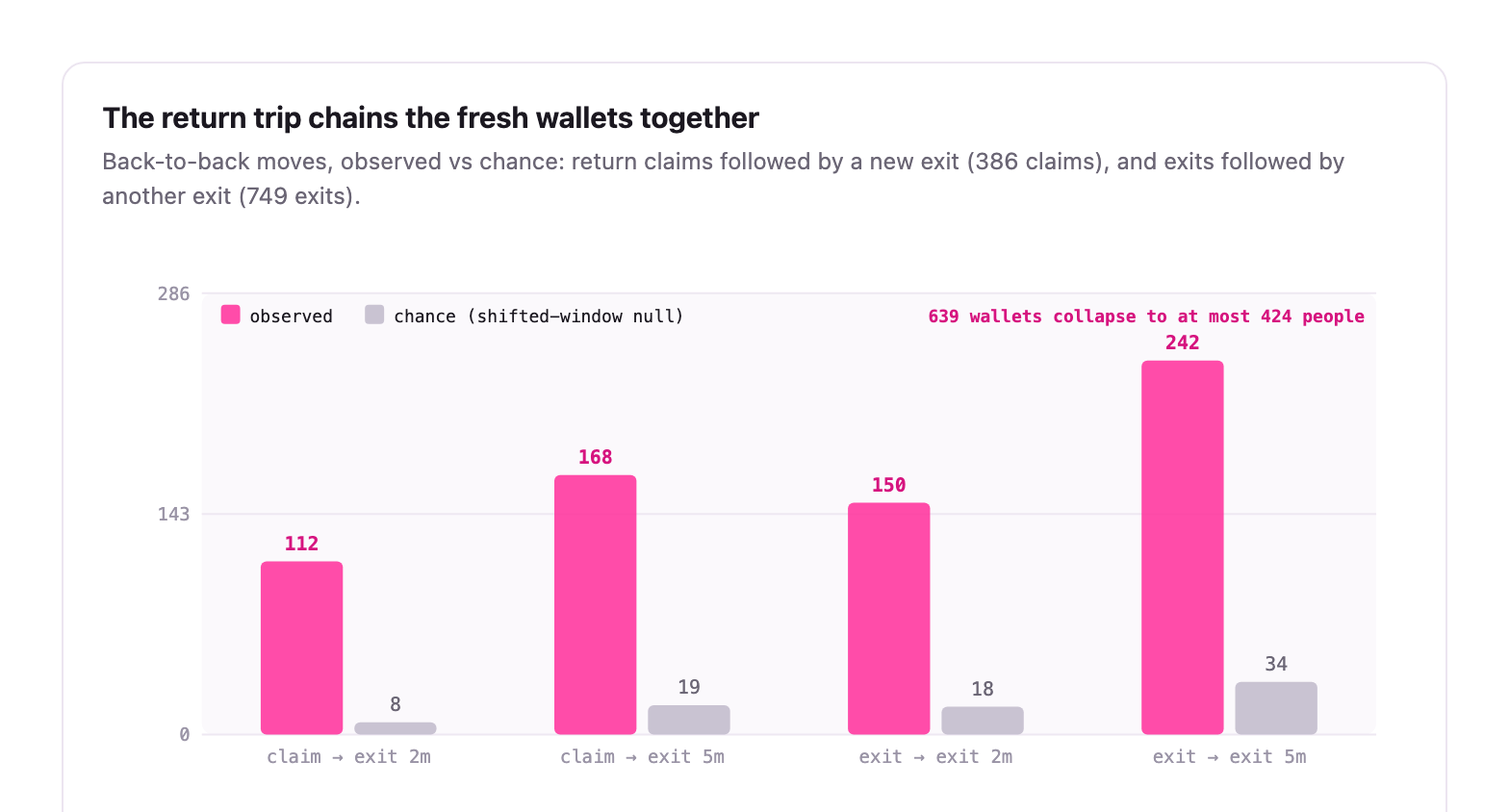
112 of 386 return claims are followed by a new exit within two minutes. Chance says 8.
The pitch says each bet gets a fresh wallet, unlinked to your other positions. The money disagrees. People do not bet once: they win, claim, and re-bridge for the next market, and they do it immediately, because the point of a five-minute coin flip is the next one. Claim-then-exit within two minutes runs 14× chance; exit-then-exit runs 8× chance (150 of 749 against a null of 18).
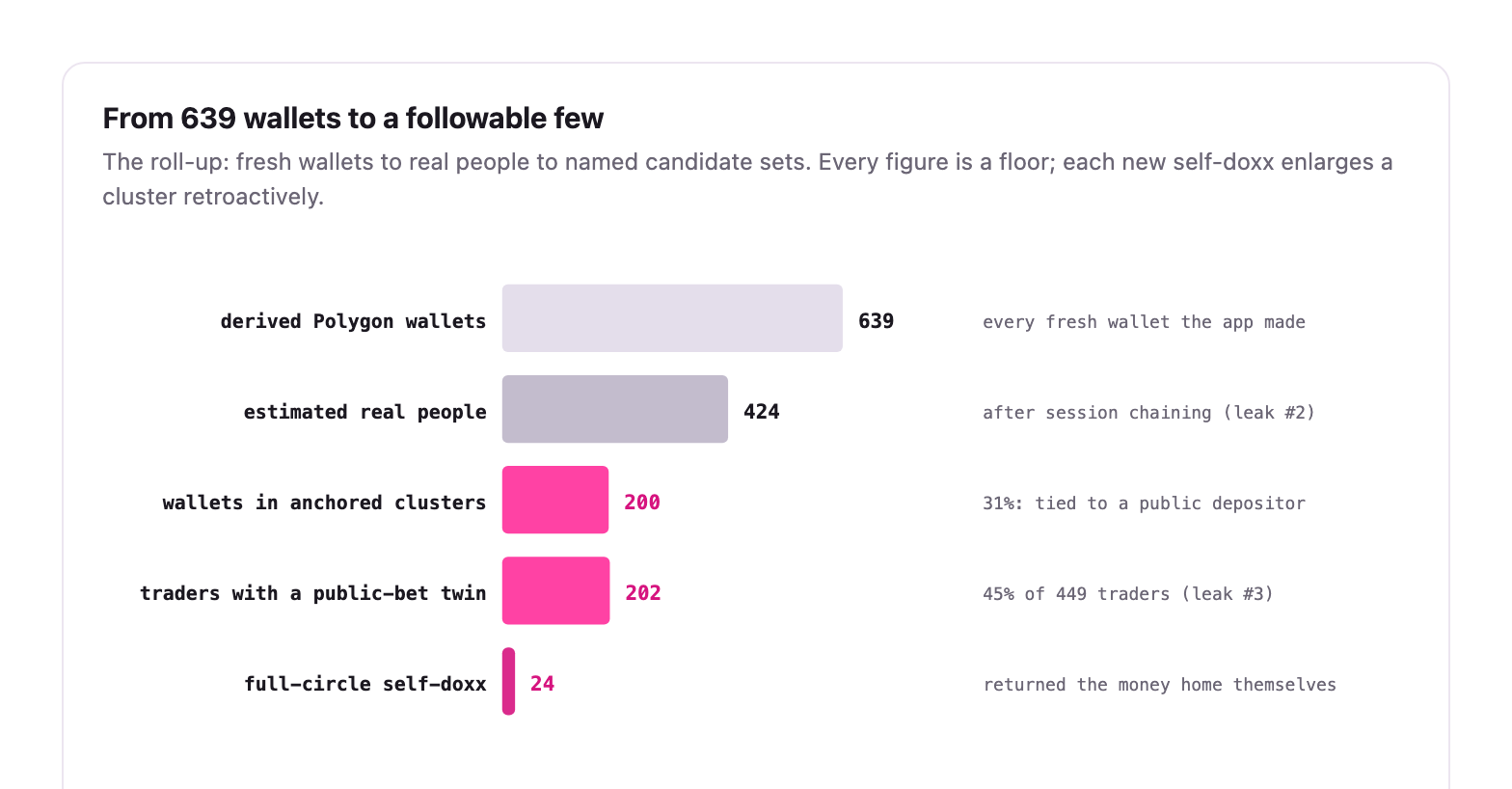
Chain the links and the crowd of 639 "random addresses" collapses into at most 424 real people. The chaining matters for a second reason: clusters share fate. Name one wallet in a cluster and the cluster is named, including every wallet it ever funded, and every future slip enlarges the cluster retroactively.
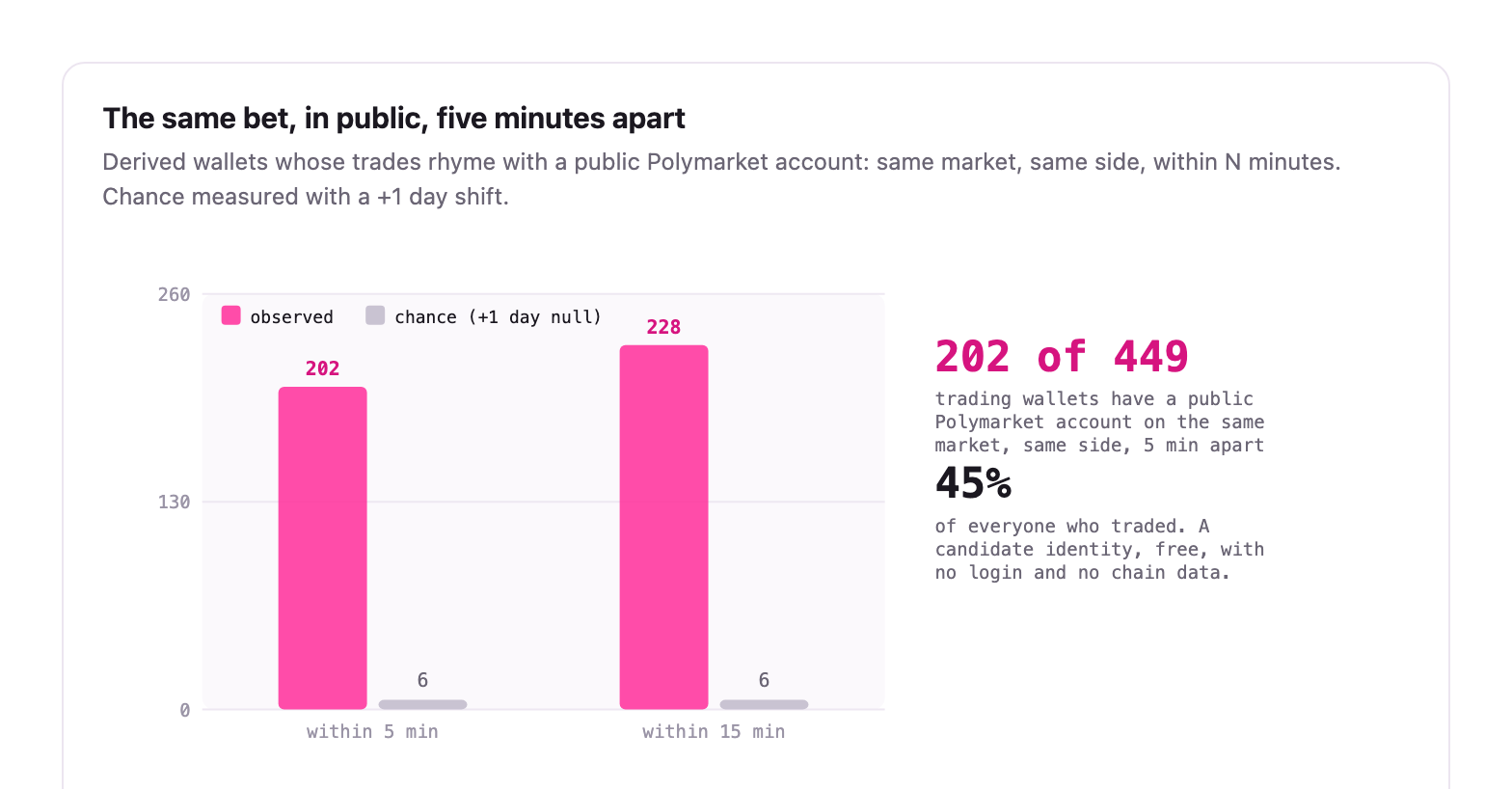
202 of 449 trading wallets (45%) have a public Polymarket account placing the same bet, same side, within five minutes. Chance says 6.
This one needs no chain data at all, just Polymarket's public trade feed and patience. People hedge, mirror, or simply forget which identity they are wearing, and their public account takes the same position their "private" wallet just took. At fifteen minutes the share rises to 51%. A match is not proof of identity; it is a candidate identity, handed to anyone who looks, for nearly half the people who traded. In the niche markets it is worse than that: when thirty-odd people worldwide are buying the same Iran contract, "same bet, same minute" is not a lead. It is a name tag.
76 return legs walked straight back to a wallet that exposes its owner: 24 derived wallets, fully tied to their Starknet funding account. Nine more paid their own gas from a linked wallet.
The app's design forces a fresh address on the way out, but it cannot stop a user walking back through the front door: winnings bridged to the same wallet that funded the original deposit, closing the circle in public. In the base STRK20 pool, 83% of users unshield where they shielded; OffMarket's flow prevents that particular sin and its users invented an equivalent one within weeks. About 5% of the cohort is doxxed full circle, Starknet account to Polygon bets and back, with zero analysis required beyond reading two chains side by side.
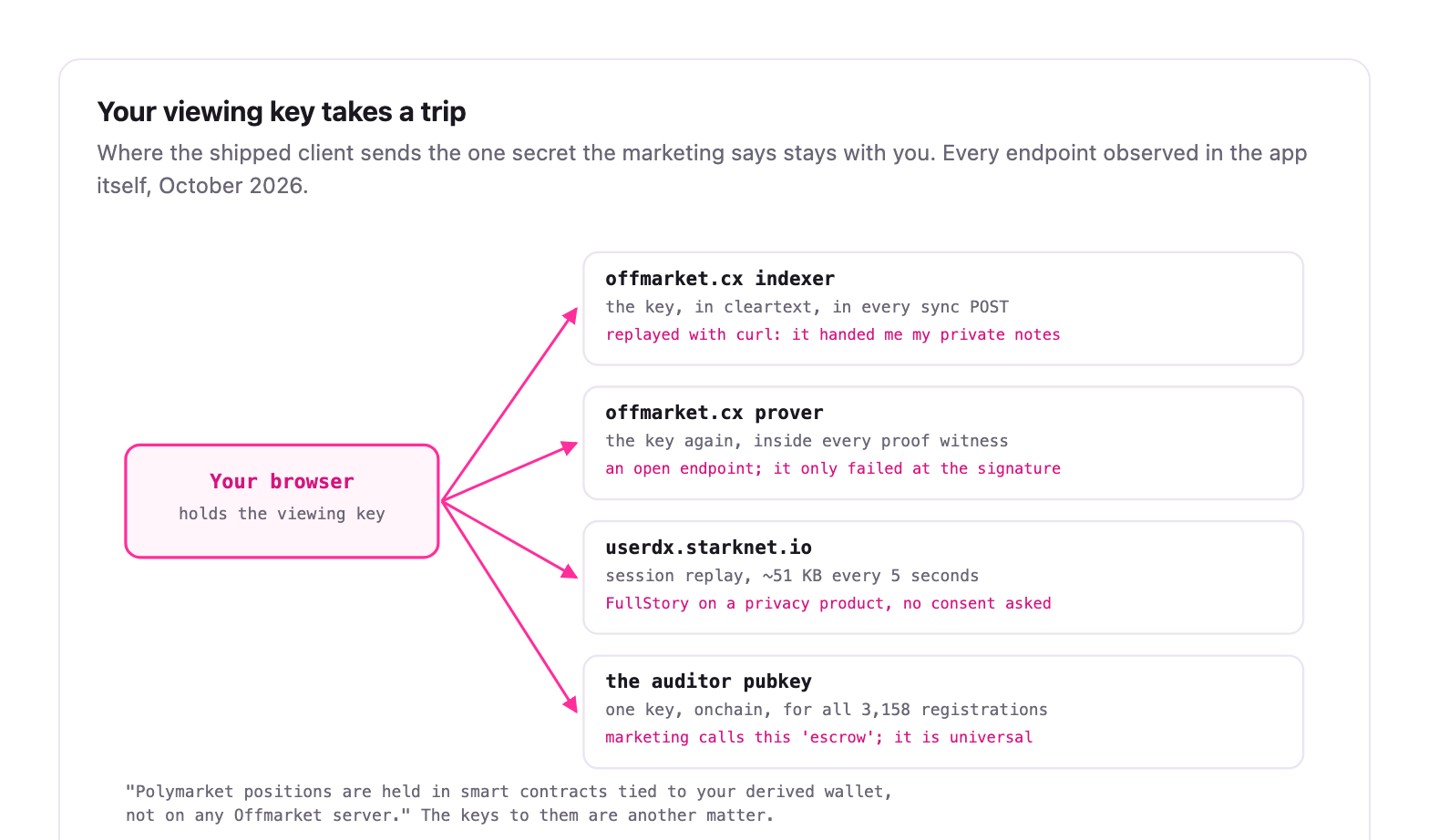
#5 · Your viewing key phones home (the server)Every sync, the app POSTs your viewing key, in cleartext, to OffMarket's own indexer. I replayed the request with curl from my own machine. It handed me my private notes.
Here is the part the chain cannot show you. To find your encrypted notes, the shipped client
calls discoverNotes, which sends your account address and your viewing key to
/indexer/v1/sync/incoming_state, plus two sibling endpoints, on every sync. The
traffic is TLS-protected, so the secret is safe from your coffee shop. It is not safe from, and
is in fact delivered to, the operator of offmarket.cx: that server, its logs, its analytics
pipeline, and anyone who later compels or compromises it can read every user's balances and
history. I know the endpoint works as described because I replayed my own session's request and
got my own notes back: 0.746988 USDC, the remainder of my dollar.
The marketing says positions are "not on any Offmarket server". The keys to them are. And this was a choice: the Starknet SDK the app is built on defaults to Oblivious HTTP, which exists precisely so the discovery server cannot see your key. OffMarket leaves it off.
#6 · The prover hears it tooThe proving endpoint is an open JSON-RPC service, and the witness it receives contains the viewing key in calldata.
Generating a withdrawal proof is heavy, so the app outsources it to /prover. That
service is reachable without authentication and speaks starknet_proveTransaction;
the payload it accepts includes the witness, and the witness carries the viewing key. I probed
it with a crafted request and it failed only at signature validation, meaning the pipeline
accepted a key-bearing witness from a stranger right up to the last check. A server that is
structurally capable of seeing every key that transits will, across enough logs and enough time,
see some.
3,158 users registered a viewing key. Every one of them is decryptable by a single auditor public key, set at deployment.
The FAQ phrases it gently: "the auditing entity holds your viewing key in escrow for compliance tracing, and no one else can access it." The onchain registry is blunter: one auditor pubkey covers every registration. The brochure calls it escrow. The contract calls it one key: a single private key, wherever it lives, can read the complete private history of every user, retroactively, silently, with no onchain footprint when used. This is the same design centre as the base pool, where one static auditor key has never been rotated. Compliance as a single point of total failure.
Three plausible attacks measurably fail, and they deserve the same ink as the hits. Amount matching is dead: linking burns to deposits by exact value lands at control level, because the pool mixes notes internally and the burn need not equal any single deposit. The relayer fleet is clean: no relayer reuses enough addresses to cluster anyone. Gas is genuinely sponsored: the classic "who paid your fresh wallet's first gas" trail does not exist, except for the nine users in #4 who paid it themselves. The cryptography, in other words, does its job. Everything that leaks, leaks around it.
SO HOW MANY PEOPLE CAN YOU ACTUALLY FOLLOW?
Add the lenses up, honestly, with their different denominators. From chain data alone, 24% of the 639 wallets sit in a cluster with a public depositor anchor; behavioural clustering lifts that to 31%. From Polymarket's public feed alone, 45% of the 449 traders pick up a candidate identity. And 5% of the cohort did the analyst's work for free, full circle. These are floors, not ceilings: I am the weakest observer in this story, working from my laptop, and every future self-doxx enlarges an existing cluster for free. The honest headline is that about a third of the cohort is followable today, and the set only grows.
MARKETING VERSUS MEASUREMENT
| THE TIN | THE MEASUREMENT |
|---|---|
| "your positions not publicly linked to your account" | 45% of traders match a public account on the same bet within 5 minutes (#3); 31% of wallets chain back to a public depositor (#1, #2) |
| "nothing linking it to your Starknet identity" | 207 exits have a deposit within five minutes, 7.4× chance; 143 have exactly one candidate (#1); 24 wallets returned the money home themselves (#4) |
| "the bridge carries no identifying information" | It carries amount and timestamp, which is all #1 needs |
| "not on any Offmarket server" | The viewing key is POSTed to OffMarket's indexer on every sync (#5), and transits its prover (#6) |
| "only your private viewing key can read them" | Plus the indexer operator, plus the prover, plus one universal auditor key covering all 3,158 registrations (#7) |
| "No administrator can access your funds or see your balance" | Funds: true, the contracts are clean. Balances: the server sees every one of them (#5) |
WHO CAN SEE WHAT
Everything above the line is what a stranger can prove. Below the line is the operational reality, the parties who see strictly more and leave no trace onchain.
| PARTY | WHAT THEY CAN SEE |
|---|---|
| The public | Every deposit, burn, fresh wallet, trade and return. Enough to anchor 31% of wallets and name candidates for 45% of traders. That is me. |
| The indexer operator | Every user's account address and viewing key on every sync, with IP and timing: full private state, by design (#5). |
| The prover | Every viewing key that transits a witness (#6). |
| The auditor key holder | Everyone, forever. One static key covering all registrations, unrotated since deployment (#7). |
| The screener (Elliptic) | Every depositor's address, amount and timestamp, pre-execution. Deposits into a privacy pool, pre-cleared by a surveillance firm. |
| The relayer | Every exit's timing, amount and shape, plus the gas trail it kindly erases for everyone except the nine who paid their own. |
| Starknet's own analytics | Full session replays via FullStory (userdx.starknet.io), ~51 KB every five seconds, no consent banner, on a privacy product. |
WHAT SHOULD CHANGE
None of this is fatal, and most of it is cheap to fix. In rough order of impact:
- Stop posting viewing keys to the server. Note discovery can run client-side, and the SDK already ships Oblivious HTTP for exactly this purpose. OffMarket turns it off. Turn it on: this single change removes leak #5.
- Prove locally, or seal the prover. If the server must prove, the witness must not carry the key. As deployed, the convenience of outsourced proving is paid for in users' secrets (#6).
- Warn before sending money home. The wallet knows when a return address has touched the pool. One interstitial kills #4, the most embarrassing leak on the list.
- Break the sitting. Enforce or at least nudge a delay between deposit and exit, and decouple claim from re-exit. Speed is the enemy of cover, and the product is currently optimised for speed (#1, #2).
- Rotate and threshold the auditor key, and publish the policy. One static key holding everyone's history is a retrospective failure waiting for a subpoena (#7).
- Remove session replay. FullStory on a privacy product is not a growth hack, it is a confession (#5, trust matrix).
- Print the fee, not just the vibe. A dollar in, 75 cents spendable, is a product fact users deserve before the deposit, not after.
CAVEATS, AND A WORD ON ETHICS
Candidates are not identities. A timing candidate or a behavioural twin is a statistical claim, and likely is not guilty. That is why every heuristic here ships with its measured chance rate, and why the strongest claims in this essay are the ones arithmetic can carry: the self-doxxed returns and the server-side key collection.
I measured the floor. The pool's interior is cryptographically opaque, and my observer is the weakest one available. The indexer, the prover, the relayer and the auditor all see strictly more than I do, and none of them leaves a trace. Where my methods disagreed across two independent pipelines, the stricter figure is the one quoted.
Aggregates only. This essay publishes counts, rates and distributions: no addresses, no names, no worked examples pointing at a real person's money. I verified the server-side findings against my own account only, with my own keys, the same standard as the base-pool study. The users of this product are small-stakes bettors who were sold privacy; the failure belongs to the product, not to them, and they deserve better engineering rather than exposure. The server-side findings were reported to the team ahead of publication.
THE BOTTOM LINE
Thirteen weeks in, OffMarket's lesson is the base pool's lesson, louder. The mathematics is fine: amounts mix, relayers behave, the gas trail is genuinely erased. What fails is everything around the mathematics: a product flow that compresses deposit, bridge and bet into one tell-tale minute; a return path users walk straight home; a behavioural echo that ties half the traders to their public accounts; and a server architecture that collects the one secret the marketing swears stays with you, then buries a universal auditor key in the FAQ's fine print. "Same markets, same odds", the advert says, "your positions not publicly linked to your account." Measured honestly: same markets, same odds, and for about a third of the people who trusted it, the same public profile they were trying to escape, rebuilt for free from a laptop. Privacy remains an engineering and hygiene discipline, not a cryptographic one. On current form the discipline falls entirely on the user, and the product works against them.
All statistics in this essay were computed from a full independent re-indexing of the STRK20 pool and anonymizer contracts on Starknet, the CCTP burn events on both chains, and Polymarket's public trade API, revalidated against the onchain record on October 15 2026. Where independent recomputation disagreed with earlier drafts, the stricter recomputed figure is used. Aggregate statistics only; no individual user is identified.
Want to know how your privacy protocol can be improved? Talk to Ben.
TALK TO BEN →